
SDFWA member’s favorite furniture design style.
The recent survey of our member’s ideas about the Fall Seminar yielded a number of interesting results. Question #7 asked SDFWA members to name the furniture design style in which they were most interested. The clear favorite turned out to be “Arts&Crafts/Mission/Greene&Greene”.
After thinking about this I realized I was not at all sure exactly how any one of these related styles differed from the others and decided to do some research. In this article I will try to summarize what I learned.
The term, “Arts & Crafts” was originally used to describe a philosophy and social reform movement rather than a specific style of furniture design. The movement developed in England in the late 1890’s, led by John Ruskin (1819-1900) and William Morris (1834-1896). Ruskin was a critic, author, socialist philosopher, artist and conservationist. He deplored capitalism, and the industrial revolution, promoted individual craftsmanship and rebelled against mechanization and the elaborate, highly decorated style of Victorian furniture.
Morris originally trained as an architect but was also an influential writer, artist, and designer. He believed that art and good design were linked to good society and, with his designs, put into practice Ruskin’s ideas about the value of craftsmanship, functional design and the beauty of natural materials. In 1861 Morris founded the firm of Morris, Marshall, Faulkner & Co. which, at first, produced stained glass and other decorative items. Furniture came later along with textiles, wallpaper, tiles and jewelry. The original “Morris” chair, sold as the “Adjustable Chair” in 1862, was inspired by a rural, traditional prototype and copied by many other makers. Hallmarks of the English Arts & Crafts furniture include simple rectilinear forms, quarter sawn oak and sturdy hand made construction.
Over time the English Arts & Crafts movement’s emphasis on craftsmanship led to the production of exceptional, more decorated pieces that only the wealthy could afford, in conflict with the ideal of well designed furniture for ordinary people.
The movement spread to America. Gustave (he dropped the e in 1903) Stickley was born in Wisconsin in 1858, the son of German immigrants named Stoeckel. He learned woodworking in his uncle’s chair factory, became manager and then the foremost maker of Arts & Crafts furniture in America. In 1883, with his brothers Albert and Charles, he founded Gustav Stickley & Co. in Susquehanna, Pa.
After traveling to England and Europe in 1895 and 1896 he became aware of the Arts & Crafts movement. Stickley visited furniture makers and was strongly influenced by their designs. By 1898 he had his own firm, The Gustav Stickley Co. in Syracuse N.Y. In 1901 he published The Craftsman, a magazine devoted to promoting the ideals of the Arts & Crafts Movement and his own designs which became very influential. Stickley furniture is characterized by unvarnished oak, exposed mortise and tenon joinery, use of vertical slats, nail head upholstery, no decoration except accents in copper, leather and tile. It was mass produced, affordable, became very popular and the style was generally called “Craftsman”.
Elbert Hubbard, also influenced by William Morris, opened the Roycroft Printing Shop in 1895, and published numerous titles and periodicals popularizing Arts & Crafts designs in both architecture and furniture. In contrast to the English movement, American Arts & Crafts furniture was produced with steam powered machines and remained affordable. Arts & Crafts was eventually applied to ceramics, textiles and metalwork as well as furniture.
The label “Mission”, originally referred to Spanish colonial architecture (U-shaped with an enclosed courtyard) in the American southwest, and came to be a synonym for “Arts & Crafts” in the early 1900’s. Stickley considered the term misleading. One version has it that a Stickley salesman of Craftsman furniture told a newspaper reporter the table in his catalog could be seen “in a Spanish Mission in Southern California.” The newspaper printed it as Mission style and the name stuck.
Hallmarks of Mission pieces include simple straight lines, substantial proportions, use of Native American symbols, leather upholstery and simple iron or copper hardware. The website of a current seller of Mission style furniture states, not very helpfully, “What ties Mission, Craftsman and Arts & Crafts style furniture together? These styles are often mixed together as one, sometimes referred to as Mission Revival. The classic mission furniture styles below feature elegantly simple designs, heavy proportion, accented joinery and wooden or brass drawer pulls.”
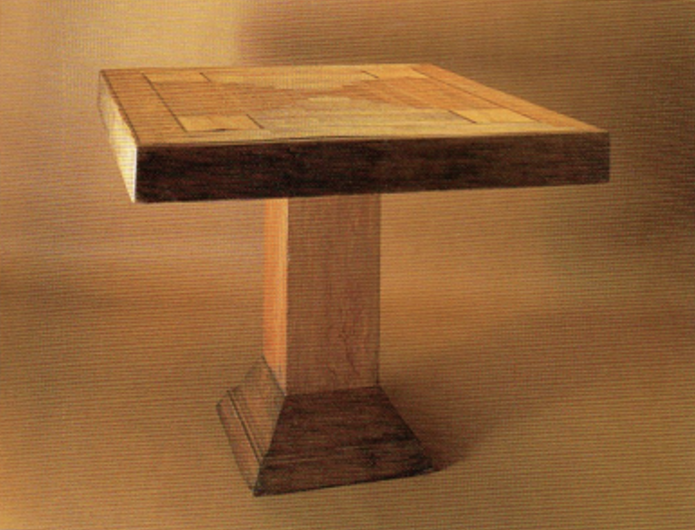
Charles and Henry Greene, born in 1868 and 1870, were raised in St. Louis, Mo. and attended the Manual Training School of Washington University learning metal and woodworking. They then completed a two year course in Architecture in the Beaux Arts curriculum of MIT in 1891 in order to be certified for an apprenticeship. After working at several respected firms in Boston they moved to Pasadena to join their parents in 1893. On the way they visited the Columbian Exposition in Chicago and were impressed by an exhibit of Japanese architecture. They began a successful architecture practice in Pasadena and began designing houses including the Gamble house in 1908. The brothers designed fixtures, built in seating and other distinctive interior elements for these homes, often using Japanese design elements. The first known piece of Greene furniture was a 42″ x 42″ table Charles built for his fiancé in 1899.
Greene & Greene furniture features a host of distinctive details; Japanese motifs for feet, brackets, drawer pulls and carvings, the Chinese cloud lift and waterfall profiles for stretchers and shelves, Scandinavian slotted screw technique, non-flush adjoining surfaces, pegged finger joints, softened edges and corners, breadboard ends for table tops, square ebony plugs, visible splines and center guider drawers just to name a few.
Greene & Greene furniture making was greatly enhanced in both quality and quantity in 1905 when they met Peter and John Hall who had immigrated from Sweden as children. After working in a Pasadena millwork shop Peter became known as a master stair builder and opened his own construction firm in 1900. John joined his brother in 1906 to make furniture for Peter’s homes.
The Hall’s expert skills and collaboration led to the production of highly refined, precisely detailed, beautiful furniture. Charles visited the shop on a daily basis, overseeing the work. Over the next decade their designs became even more sophisticated and included more decoration. Charles had always had an interest in carving and some of their late pieces included striking examples of his work.
Hopefully this article provides more clarity than confusion about these wonderful styles. Here is a list with hyperlinks to some of the references used in preparing it.
https://www.popularwoodworking.com/projects/inside-greene-and-greene-furniture
A nice collection of illustrations of Greene & Greene style elements.
https://www.stickleymuseum.org/explore/collections/
A collection of Gustav Stickely pieces.
http://www.victorianweb.org/authors/morris/morisco.html
A detailed history of the William Morris Co.
http://char.txa.cornell.edu/art/decart/artcraft/artcraft.htm
A brief history of the English Arts & Crafts Movement.
http://www.artnet.com/Magazine/features/garrett/garrett9-15-00.asp
A history of the Greene and Greene furniture production with illustrations.
https://www.utoledo.edu/library/canaday/exhibits/artsandcrafts/table.html
An extensive history of the Arts & Crafts Movement in America.
http://williammorristile.com/index.html
A voluminous website of the Morris Tile Co. devoted illustrations of William Morris designs.
By Dick Ugoretz (originally published on January 2018)
Editor’s Note: Light edits have been made to remove broken web links.